
PVA fiber Performance for Seaweed Farming
PVA fiber combines exceptional hydrophilicity and durability, making it well suited for seaweed farming applications.
For certain seaweed species, it has demonstrated superior spore attachment and spore germination performance compared with conventional synthetic fibers.
As shown in the graph below, spore attachment tests on Ulva prolifera confirmed that both PVA fiber spun yarn and filament exhibited higher levels of spore attachment than common synthetic fibers such as polyester and polypropylene.
Germination count on yarn surface (Count/Unit)
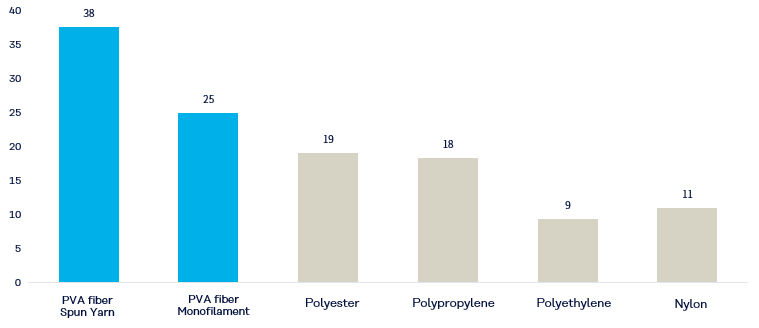
* Surveyed with zoospore seeding of Ulva Prolifera by Tokushima University (Japan, 2019)
*Materials other than PVA fiber were standard fishing net materials.
Different seaweed species, cultivation environments, and farming methods require different substrate characteristics.
Leveraging the versatility of fiber, which can be processed into ropes, nets, and various yarn forms, we can provide solutions tailored to diverse seaweed cultivation methods.
Spun yarn・Rope(Twine)
Since the 1950s, PVA fiber has been trusted as seaweed cultivation seedling ropes.
The surface characteristics of spun yarns and ropes promote spore attachment during the nursery stage and help reduce detachment during offshore cultivation. They are widely used in conventional seeding-rope cultivation methods, particularly in relatively calm marine environments.
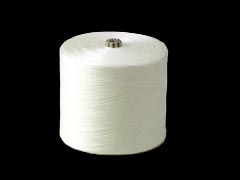
●Spun yarn
| Item | Cotton Count | Strength (cN) | Elongation (%) |
|---|---|---|---|
| Spun yarn 10/1 | 10 | 2,900 | 8.7 |
| Spun yarn 20/1 | 20 | 1,390 | 8.2 |
| Spun yarn 30/1 | 30 | 840 | 8.0 |
●Spun yarn rope(twine)
Spun yarn ropes are marketed by various rope manufacturers. The figures shown below are for reference only.
| Item | Thickness (㎜) | Length (m/kg) | Remarks |
|---|---|---|---|
| Spun yarn twine #12 | 1.6 | 725 | Standard |
| Spun yarn twine #5 | 1.0 | 1,860 | Finest |
| Spun yarn twine #20 | 2.1 | 435 | Thickest |

Monofilament
In nori cultivation, nets are wrapped around large seeding wheels on land to attach seaweed spores to the net surface.
PVA fiber monofilaments are widely used for this process because they provide consistent and optimized spore attachment during seeding operations.
In addition, their high tensile strength makes them suitable for cultivation sites exposed to demanding wave and current conditions.

Microscopic image of seaweed spores attached to a PVA monofilament
●KURALON™ PVA fiber Type:Monofilament
| Item | Fineness (dtex) | Strength (N) | Elongation (%) |
|---|---|---|---|
| KURALON™ 1101 1100/2 | 1,100 | 41 | 29.6 |
| KURALON™ 1101 2200/4 | 2,200 | 81 | 29.6 |

Multifilament
PVA fiber multifilament yarn is being evaluated for emerging seaweed cultivation technologies, including direct seeding methods designed to improve cultivation efficiency.
Along with its excellent tensile strength, the smooth surface characteristics of multifilament yarn can provide favorable performance for specific seaweed species and cultivation methods.
●KURALON™ PVA fiber Type:Multifilament
| Item | Fineness (dtex) | Strength (N) | Elongation (%) |
|---|---|---|---|
| KURALON™ 1225-7 | 1,111 | 93 | 9.2 |

※These values are typical and not guaranteed.
