Blue Carbon Opportunities and the Expansion of Seaweed Farming
Efforts to reduce greenhouse gas emissions and achieve carbon neutrality are accelerating worldwide. At the same time, interest is growing in negative-emission approaches that remove and store atmospheric CO₂.
Among these solutions, blue carbon has attracted increasing attention for its potential to support carbon sequestration while contributing to marine ecosystem conservation and the sustainable use of ocean resources.

1.What is Blue Carbon?
The term blue carbon refers to carbon captured and stored by marine and coastal ecosystems. While carbon sequestration by forests is often referred to as green carbon, blue carbon focuses on the role of oceans and coastal environments in the global carbon cycle.
As seaweeds and seagrasses grow, they absorb CO₂ through photosynthesis. A portion of the carbon assimilated into their biomass may ultimately be transferred to marine sediments or other long-term carbon pools. This process is commonly associated with blue carbon initiatives.
Seaweed habitats can therefore function not only as carbon sinks but also as valuable ecosystems that provide habitat for a wide variety of marine organisms.
2.Growing Interest in Blue Carbon
Many countries have established carbon-neutrality targets for 2050 and are actively pursuing strategies to reduce greenhouse gas emissions. In addition to emissions reduction, interest continues to grow in technologies and nature-based solutions that remove CO₂ from the atmosphere.
Blue carbon has emerged as a promising approach because it offers several potential benefits:
- Utilization of marine and coastal environments
- Compatibility with marine ecosystem restoration efforts
- Integration with seaweed farming and seagrass conservation initiatives
- Generation of environmental and socioeconomic value
As a result, interest in both blue carbon projects and the broader seaweed cultivation industry continues to expand worldwide.
3.The Role of Seaweed in Marine Ecosystems
CO₂ Uptake and Carbon Sequestration
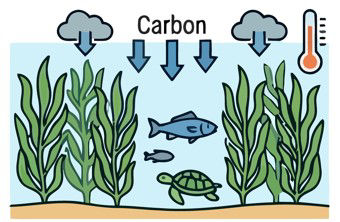
Seaweeds absorb CO₂ through photosynthesis as they grow. The ocean plays a critical role in the global carbon cycle. Against this background, habitat restoration is increasingly being explored as part of blue carbon initiatives.
Environmental Benefits of Seaweed Habitats
Seaweed habitats provide benefits beyond carbon sequestration.
Seaweed communities create important habitat for marine organisms and contribute to biodiversity conservation.
The conservation of seaweed habitats is also expected to help enhance fisheries resources and improve coastal water quality.

4.Seaweed Farming as a Foundation for Blue Carbon
Growing Interest in Seaweed Farming
As awareness of blue carbon increases, interest in seaweed farming is also expanding.
In Japan, local governments, universities, research institutions, and private companies are engaged in projects related to seaweed habitat restoration and seaweed cultivation. Similar initiatives are emerging globally, driven not only by demand for food products but also by growing interest in environmental sustainability, carbon management, and new marine industries.
The Importance of Cultivation Equipment
Seaweed farming relies on cultivation materials such as seeding ropes and cultivation nets. To successfully cultivate seaweed, these materials play important roles in providing reliable substrates for spore attachment during the nursery stage and supporting offshore cultivation.
As seaweed cultivation technologies continue to evolve, increasing attention is being paid to the performance of cultivation substrates and supporting materials that contribute to efficient and reliable production.