
Key performance of KURALON™
Alkali resistance

KURALON™ has a polymer backbone composed of carbon–carbon (C–C) bonds that are resistant to alkaline degradation.
It does not contain hydrolyzable functional groups, such as ester linkages, which contributes to its stability.
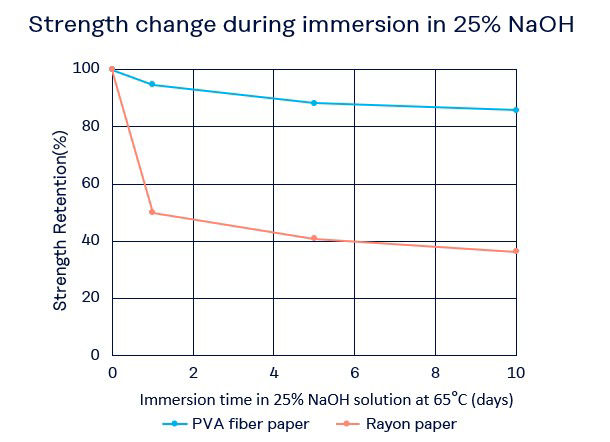
The graph below compares the alkali resistance of PVA fiber paper and rayon paper.
In addition to the stability of its molecular structure, PVA fiber paper exhibits lower swelling in alkaline aqueous solutions,which helps suppress structural changes in the paper.
As a result, PVA fiber paper maintains a higher strength retention rate than rayon paper.
ーSampleー
・PVA fiber paper・・・Structural fiber:KURALON™ 80% /Binder fiber:KURALON™ 20%, Weight 80g/m2
・Rayon paper・・・Structural fiber:Rayon 80% /Binder fiber:KURALON™ 20%, Weight 80g/m2
(In-house measurement)
Good affinity with pulp, rayon, and galass fiber.

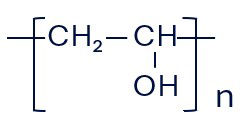
KURALON™ contains hydroxyl (OH) groups, which provide excellent compatibility with various materials such as pulp, rayon, and glass fiber.
Hydrophilicity

KURALON™ contains hydroxyl (OH) groups, which contribute to high hydrophilicity and excellent affinity for water.
Function as a binder fiber

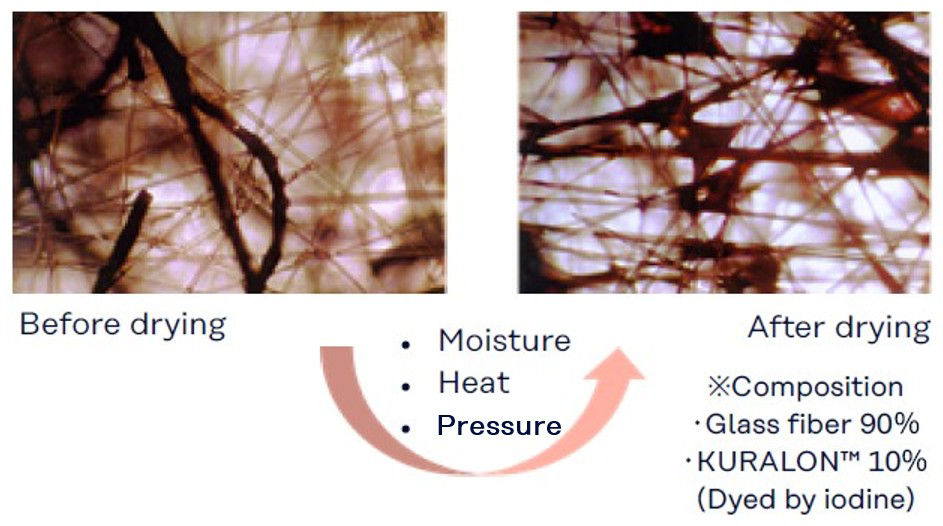
Binder fibers are fibrous adhesives. When exposed to moisture, heat, or press pressure during the papermaking process, they dissolve and form a film between fibers, providing strong bonding.
KURALON™ can be used not only for organic fibers such as pulp and rayon, but also for inorganic fibers such as glass fiber and carbon fiber.
Control paper pore size

The PVA structural fibers range from 0.55 dtex to 17 dtex.
The PVA binder fibers range from 0.6 dtex to 2.7 dtex.
The variations in fineness enable precise control of paper pore size.
A wide range of products

We offer an extensive fiber lineup, including general-purpose products, binders for glass paper, and binders for water-dissolvable paper.
